
European Union Methane Regulation:
Verification & Reporting Protocol
Version 1.0
This protocol was developed by the Energy Emissions Modeling and Data Lab (EEMDL), which is one of several emissions-related programs at The University of Texas at Austin’s Center for Energy and Environmental Systems Analysis (CEESA). EEMDL is a joint research initiative of UT Austin, Colorado State University and the Colorado School of Mines.
BACKGROUND
Starting January 1, 2027, operators supplying natural gas and crude oil to the European Union will be required to begin implementing methane monitoring, reporting, and verification (MRV) systems aligned with EU import standards. This regulation has implications for global oil, gas and LNG suppliers, as well as for oil, gas and LNG buyers in other regions.
The EU Methane Regulation (EUMR) is the first regulation of its kind in the world, and it places a central challenge on independent third-party verification of emissions data. Even for companies aligned with OGMP 2.0, the EUMR requires independent third-party verification at a “reasonable assurance” level. While the EUMR does not define “reasonable assurance,” ISO 14064-3 provides an established framework for reasonable assurance in the verification of greenhouse gas statements.
Accordingly, EEMDL has developed a protocol that draws on the international standards framework to establish a structured approach to verification and evidence evaluation. This protocol is designed to support clarity, consistency, credibility, and comparability in methane reporting and verification worldwide. It reflects EEMDL’s expertise in methane emissions measurement, OGMP alignment, and global energy supply chains, along with extensive stakeholder review and feedback.
The accompanying technical reporting protocol provides a practical, assurance-ready framework for producer-level methane measurement, quantification, reconciliation, and reporting. It is designed to support implementation of Article 12 during the period before applicable standards and technical prescriptions contemplated under Article 32 take effect, reflecting the EUMR’s interim reliance on state-of-the-art industry practices and best available technologies for methane measurement and quantification, informed by EEMDL’s technical expertise and experience in methane measurement science and reporting.
GLOBAL STAKEHOLDER CONSULTATION
Researchers at EEMDL have solicited detailed input from a wide array of global stakeholders during the development of the Verification and Reporting Protocol.
Through workshops, webinars, bilateral technical sessions and other outreach activities, our researchers engaged stakeholders representing:
More than 200 organizations
More than 40 countries
Major energy exporting and importing regions, including Europe, Asia, the Middle East, Africa and North America.
Key segments of the global energy sector, including onshore and offshore energy producers, export terminal operators, national oil companies, integrated oil companies, assurance providers, and technology providers.
The final protocol also reflects consultation and review from both the European Commission and the European co-operation for Accreditation (EA), which is the official network of National Accreditation Bodies (NABs) in Europe.
THE VERIFICATION AND TECHNICAL REPORTING PROTOCOLS
EEMDL has developed two companion protocols designed to work together to support credible methane emissions reporting and independent verification in connection with the EUMR:
1.Verification Protocol – A framework for independent third-party verification of producer-level methane emissions reports, based on international assurance standards (including ISO 14064-3, ISO 14065, and ISO/IEC 17029) and informed by relevant EU verification precedents.
This verification framework:
Establishes requirements for verifier competence, impartiality, independence, and quality management.
Defines the verification process, including engagement scope, reasonable assurance, risk assessment, evidence gathering, site visits, materiality assessment, and evaluation of misstatements and nonconformities.
Establishes requirements for verification documentation, independent review, and issuance of the verification statement.
Provides a consistent framework for evaluating whether producer-level methane emissions reports have been prepared, in all material respects, in accordance with applicable monitoring and reporting criteria.
2.Technical Reporting Protocol(Annex A) – A technical reporting framework for producers seeking to demonstrate that their monitoring and reporting measures are equivalent to the requirements of Article 12 for purposes of the Article 28(5) equivalence pathway.
This technical reporting framework:
Establishes technical criteria for defining reporting boundaries and identifying and quantifying applicable methane emission sources.
Provides a hierarchy of source-level measurement and quantification methods, together with requirements for measurement quality, method selection, and supporting data.
Establishes requirements for site-level measurement and for reconciliation of source-level and site-level evidence into a final producer-level methane emissions inventory.
Specifies reporting, documentation, data-management, and QA/QC requirements designed to support independent verification and the provision of producer-level information relevant to Annex IX.
Together, the protocols are intended to provide a consistent and technically rigorous framework for preparing and independently verifying producer-level methane emissions information. They are designed to reduce unnecessary variation in reporting and verification approaches while preserving the professional judgment required in independent assurance engagements.
The protocols are designed to support application of the EUMR, do not provide a legally binding interpretation of the Regulation, or replace applicable requirements established by the European Commission, Competent Authorities, or subsequently applicable standards or technical prescriptions.
The work is also part of a broader research program at UT Austin focused on methane emissions and production and consumption patterns across the global energy sector. Elements of the frameworks may therefore have broader application to U.S. and international oil and natural gas supply chains where producers, buyers, regulators, or other stakeholders seek credible, measurement-informed emissions information and independent assurance.
A Protocol for Independent Verification of Methane Emissions of Crude Oil and Natural Gas Production Placed on the European Union Market
Version 1.0 | August 2026
To download the Final Protocol, please fill out this form.
PRESENTATION OF FINDINGS AT EEMDL 2026 ANNUAL EVENT
McKetta Department of Chemical Engineering Professor of Practice Erin Tullos, the author of the Verification and Reporting Protocol, will provide an update on this research initiative at the EEMDL 2026 Annual Event, to be held Oct. 13-15 on the campus of UT Austin.
For registration details, please visit the EEMDL 2026 event page.
WEBINARS & WORKSHOPS
A series of webinars and in-person workshops were held during the global stakeholder consultation process, providing an opportunity for global participants to engage directly and ask questions. Recordings of these webinars can be accessed below.
Please note that while the core content is consistent across sessions, the audience and questions vary.

Webinar Recording
Date: September 23, 2025
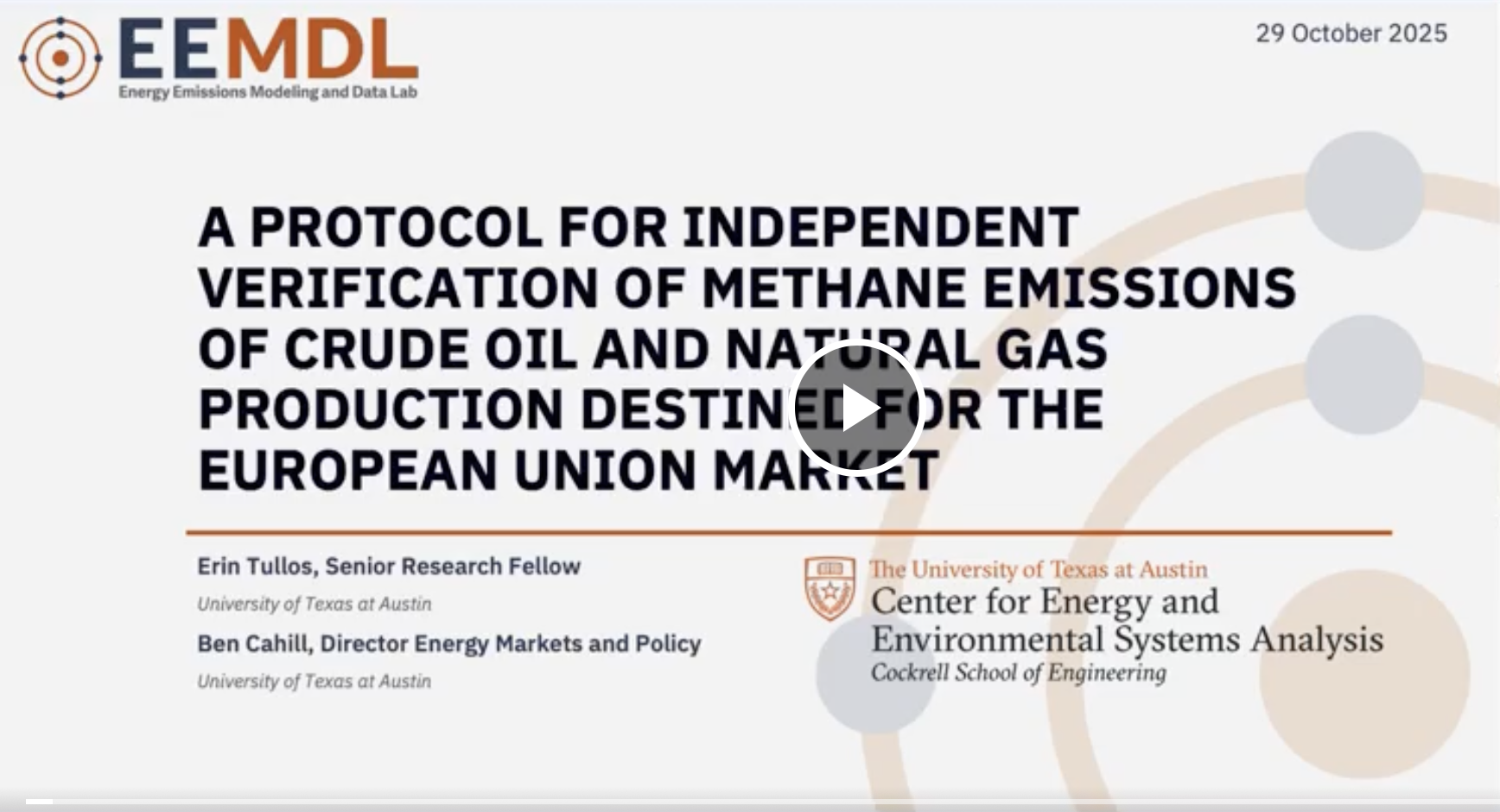
Webinar Recording
Date: October 29, 2025

Webinar Recording
Date: November 6, 2025
Connect with us
Stakeholder questions on the Verification and Reporting Protocol can be submitted to: ceesa@utexas.edu